Riskiest Assumption
Identify the riskiest assumption related to your solution.
The Riskiest Assumption activity will help you identify any assumptions you have about the problem and the solution. Assumptions are things we believe is generally true without any evidence. Assumptions can exist throughout all parts of the problem solving journey. Assumptions can fall under 3 categories: desirability, feasibility, and viability. Some will be true and some will be false.
Desirability: Assumptions related to the problem and the customer. Do they have a problem? Do they want this solution?
Feasibility: Assumptions related to whether it is possible to do. Can we do this?
Viability: Assumptions related to sustainability of the business. Should we do this?
Use this activity to prioritize the assumptions your team has and test the riskiest ones first. The highest risk is making something no one wants. Validating your Riskiest Assumption early will help you quickly learn whether your solution will either be desirable, feasible, or viable before you spend too much time and resources on it.
If your Riskiest Assumption fails validation, you may have to make some adjustments or pivot. If your Riskiest Assumption is valid, you’ll be able to move forward with your solution, do more experiments, and validate the next assumption(s).
 4-6 people
 60 minutes
What you’ll need
- Pens or markers
- Sticky notes (3 colors)
Prerequisite Activities
- None
Downloadable Materials
Instructions
Identify the assumptions
Assumptions can fall under 3 categories: desirability, feasibility, and viability. Use a different color sticky note for each category. Write one assumption or question per sticky note. What are your assumptions? What are you unsure of?
Reference previous activities such as Value Proposition Canvas, Business Model Canvas, Future Journey Map, and/or Persona, to get an understanding of the solution, business model, and context.
Use these questions to guide what assumptions you may have:
Desirability: do they want this?
- Who are the target users for your solution?
- What problem do your users want to solve?
- What job or task do your users want to accomplish?
- How do your users solve this problem today?
- What is the outcome your users want to achieve?
- Why will your users stop using their current solution?
Feasibility: can we do this?
- What are your biggest technical challenges?
- What are your biggest legal or regulatory risks?
- Why does your leadership team support this solution?
- Where does your funding for this solution come from?
- Why is your team uniquely positioned to win?
Viability: should we do this?
- What are your main channels for obtaining users?
- How will your users repeatedly use your solution?
- Why will your users refer to new customers?
- How does this solution support your company vision?
- Who are your solution’s primary competitors?
- How will your solution generate revenue?
Map the assumptions
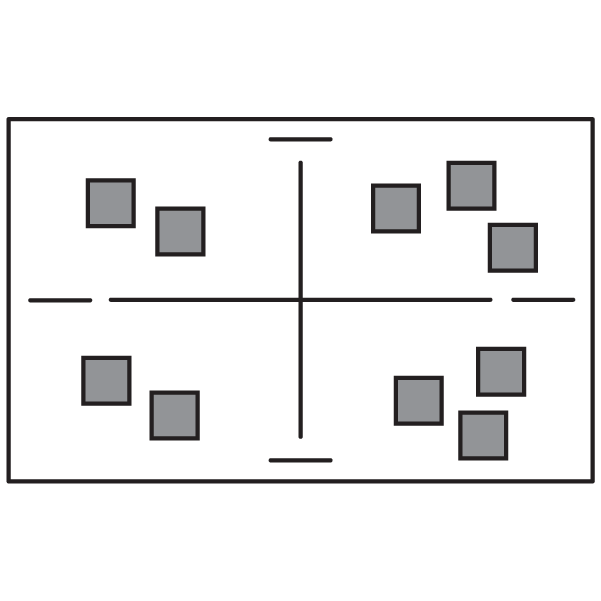
Use the worksheet. The vertical axis is from high-risk at the top to low-risk at the bottom. The horizontal axis is from low uncertainty on the left and high uncertainty on the right.
Individually and silently plot all the assumptions based on these 2 questions:
Uncertainty: How much do you know about this assumption? Consider whether you have evidence to validate or invalidate your assumption. Have you spoken to users?
Risk: How much impact does this assumption have on the business, if it turns out false? Consider whether the business will fail if this assumption is false. Is this important for business success? Can this be deferred and addressed later?
Identify which assumptions to test first
Take turns reading the assumptions from each quadrant. Then, as a group, discuss the current placement of each assumption. Re-arrange in relation to each other. Move any down if it is less important or dependent on another assumption. Move any up if it is riskier or must be true for your solution to work.
Each quadrant has a recommended action:
Top-right:
Test first. These are your riskiest assumptions. They have the highest impact on the success of your solution and business. These much be validated and true in order for your solution to be successful.
Top-left:
Plan for development. These are closer to facts than assumptions. You have evidence that they’re true and feel confident about.
Bottom-right:
Look for more insights and opportunities. These assumptions can lead to further research to learn more about users and discover meaningful problems to solve.
Bottom-left:
Defer commitment; don’t address it now. These assumptions aren’t critical for making time to experiment and test.
Prioritize Riskiest Assumptions
Take the riskiest assumptions in the upper-right quadrant and arrange them in a list based on priority. Identify the riskiest assumption within this set; this will be at the top. If there are multiple assumptions, the team should vote. Give one dot sticker to each person. Have each person place a sticker on the one assumption that they think is the riskiest. Refer to Dot Voting if necessary.
For the riskiest assumption, discuss what this assumption means. When is this assumption considered true? Does this assumption depend on other assumptions?
You want to end with a clear idea of what your riskiest assumptions are and which one is the biggest risk.
Discuss experiments
For each item, briefly discuss ways to test these assumptions. Write how you could test these assumptions next to the assumption. Do you need to do direct observation to validate it? Do you need to build a prototype to test? Is there an expert within this domain who you can directly speak to?
Next Steps
You’re ready to create an experiment to validate your Riskiest Assumptions and learn about your solution.
Revisit Assumptions
Revisit this activity after experiments to review assumptions and mark assumptions as validated or invalidated. This helps you keep track of assumptions.
Validated Assumptions: These are assumptions that you’ve already validated. These assumptions have been tested and results were true. If this is your first iteration, you might not have any.
Invalidated Assumptions: These are assumptions that you’ve already invalidated. These assumptions have been tested and results were false. If this is your first iteration, you might not have any.