Empathy Map
Understand the perspective, motivations, and pain points of your target user.
The Empathy Map helps you understand a user’s perspective and have empathy for your users. It allows you to summarize information and learnings about your users and communicate it to others. It has six key areas: what did the user do, say, think, and feel, and what are their pain points and hopes? Use the Empathy Map to create alignment and aid in decision making with your team. Create one empathy map for each persona type.
 2-4 people
 60 minutes
Instructions
Gather your personas
You’ll need the Personas you created and any information about your users to help create the Empathy Map.

Define the focus
You’ll be creating one empathy map for each persona. Add your persona’s name and goal.

Tip
If you have multiple personas, consider breaking into groups to complete them.
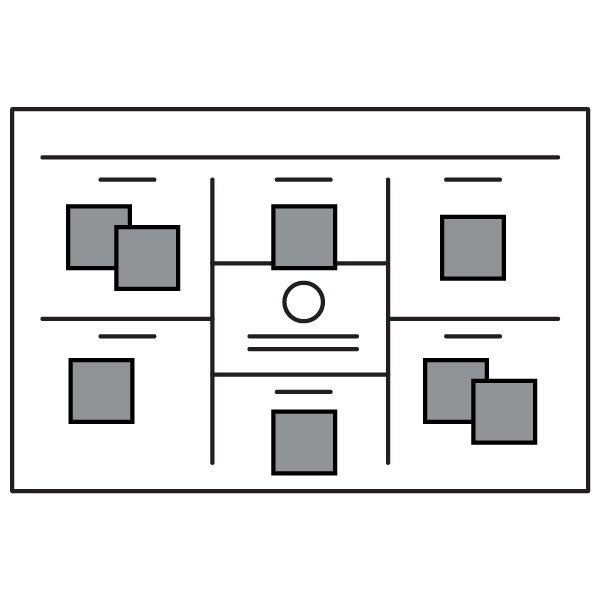
Capture what they do and say
For each section, add notes based on your understanding of the user.
What did the user do?
Describe actions and behaviors you noticed. Consider the things they aren’t doing and any workarounds to understand the motivation behind the behavior. You can add pictures of your users in action or drawings of how your users were moving in a space.
What did the user say?
Write down significant quotes and keywords that the user said.
Capture what they think and feel
For each section, add notes based on your understanding of the user.
What did the user think?
Write down thoughts that the user might be thinking. The contents for “say” and “think” can be the same. What might your user be thinking and cannot say? Their thinking can help us understand their motivations and desires.
How did the user feel?
Write down an emotion your user is feeling and a short sentence to explain the context of the emotion. Did you notice subtle cues such as body language, facial expressions, word choice, and tone of voice?
Capture their hopes and challenges
For each section, add notes based on your understanding of the user.
What are your user’s hopes?
Write down any hopes, outcomes, or wins that the user may expect after accomplishing the goal.
What are your user’s challenges?
Write down your user’s challenges and a short sentence to explain why it is a pain for them. A challenge can include any fears, frustrations, pain points, or obstacles that the user may have when trying to accomplish the goal.
Review with the team
Summarize the empathy map. Identify the most important aspects in each section. If there are notes with a common theme, group them together and add another note to summarize those notes.
If there is missing information, consider doing more information gathering to get a better understanding of your users.
Refer back
You can make adjustments to the empathy map as you learn more about your users.
Tip
Display this empathy map in a space that is easy for everyone to see and keep the user in mind.